The AI Classroom Divide Inside Our Schools
When our founder & CEO Elizabeth Tweedale walks into a school, she isn't there to debate the philosophy of artificial intelligence - she is there to look at the data.
Having spent her time in the trenches with students, parents, and educators, what she has uncovered repeatedly is a reality that completely upends the current debate: the panic over banning AI in schools and the urgency to teach it are not opposing positions. They are two reactions to the exact same data.
The real crisis isn’t if students should use AI, but the dangerous gray zone created when schools pretend it isn't already there.
The 100% Reality Check
Elizabeth recently brought this message to a presentation at the Rotary Club of Tahoe-Incline, where an attendee immediately pushed back. Passionate and deeply concerned, he argued that AI was dangerous, untrustworthy, and should be kept away from children entirely.
Elizabeth didn't try to change his mind by dismissing his fears. Instead, she agreed with them- and then dropped a series of undeniable statistics that changed the entire conversation.
The turning point comes down to a massive disconnect between what adults believe is happening, and what is actually happening in the classroom.
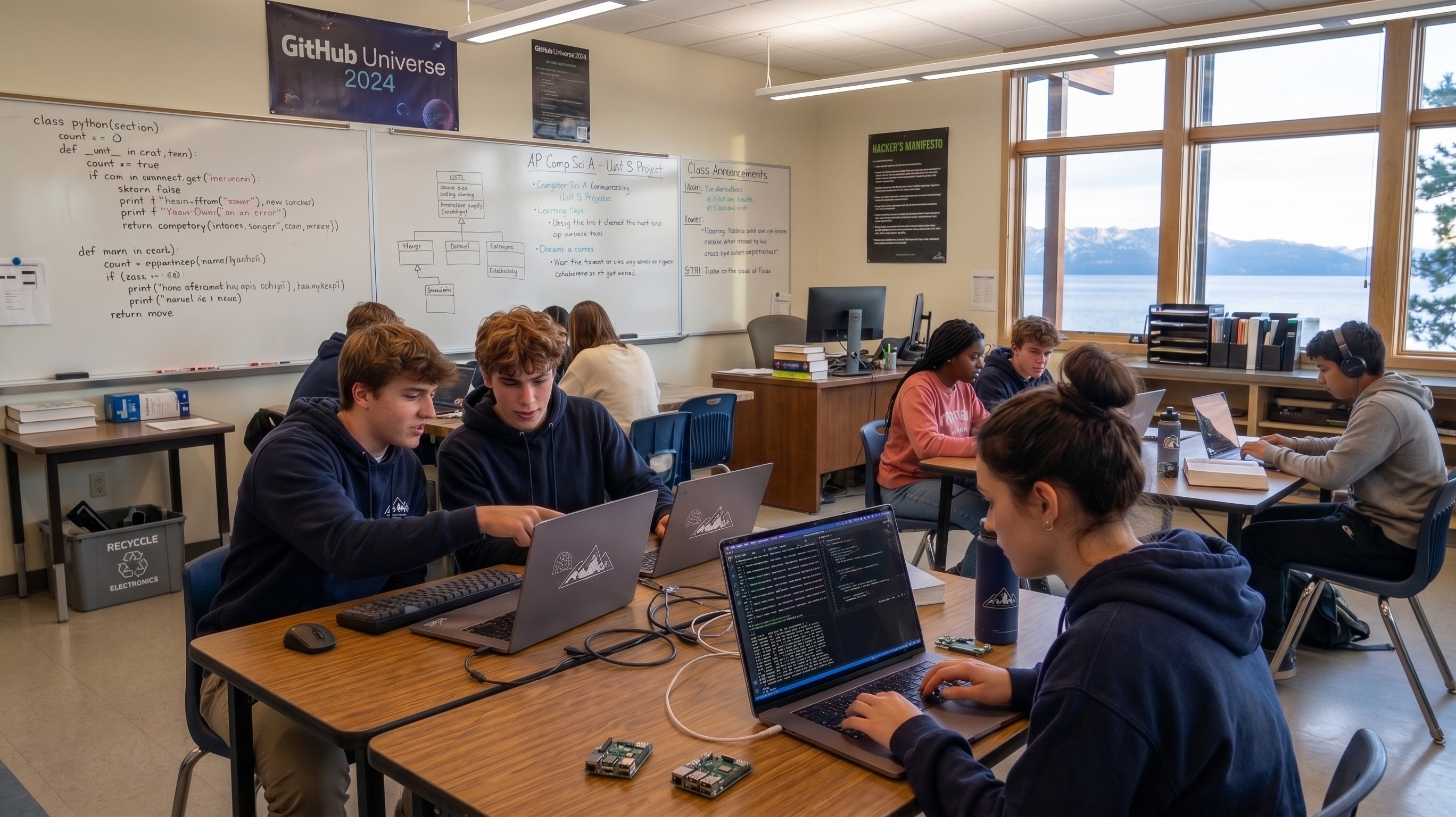
When Elizabeth asked the freshman and sophomore Critical Issues class at Incline High School who was using AI, it wasn't a handful of tech-savvy kids. It was every single student in the room.
AI hasn’t just entered these children's lives; it is actively shaping how they search, write, create, and think. Elizabeth pointed out to the Rotary club that banning a tool that 100% of students are already using doesn't protect them - it just ensures no one is teaching them how to use it safely.
Inside the Classroom: Splitting the Vote
To understand what this total lack of guidance looks like in practice, Elizabeth ran an experiment during her Incline High School workshop. She asked the students to vote on specific everyday AI scenarios.
The results revealed deep confusion and anxiety among the students themselves:
"Is it acceptable to use AI to write an outline for an essay?" The room split sharply down the middle.
"Is it okay to have AI write the first draft if you wrote the outline?" Again, the students fiercely divided.
When Elizabeth asked the critical question—"Do you know your school's official policy on AI?" - the response was unanimous: total uncertainty.
This classroom chaos is a direct reflection of a massive nationwide systemic failure. According to data from Common Sense Media, the problem isn't isolated to one school:
6 in 10 American teens report that their school either has zero rules regarding generative AI, or they have no idea if rules exist.
83% of parents say their child’s school has never communicated with them about AI in any form.
46% of students who use AI for school assignments admit to doing so without their teacher's permission, while another 12% have no idea if they have permission or not.
As Elizabeth observes, students are walking into six to eight different classrooms a day, carrying their own privately formed assumptions about what is "honest" and guessing what each individual teacher expects.
While states like Nevada have published high-level AI ethics guidance, Elizabeth notes that a policy framework is not a classroom curriculum. These documents don't teach a math or English teacher how to handle a 45-minute period full of students at wildly different tech-fluency levels, using tools that didn't exist when the teacher went to college.
This is where Elizabeth’s work with Coco Coders shifts from policy to a practical solution.
AI literacy requires going a step deeper than a checklist of rules. Before a student can evaluate whether a machine learning model is lying to them, they need to understand how algorithms are written and how computers process data.
By targeting children in the 6-to-14-year-old window, Coco Coders builds this foundational digital judgment early - before the massive pressures of high school GPAs, college applications, and academic integrity violations lock in poor habits.
The Takeaway
Elizabeth's time in schools proves that the current educational divide isn't between those who want AI and those who fear it. Both sides are staring at the same fast-moving digital landscape. The difference is that one approach tries to build a wall against a flood that is already inside the building, while Elizabeth is handing students the tools to navigate the waters safely.
Help your child build the critical thinking and digital judgment they need to thrive. Sign up for Coco Coders' weekly online coding classes here.